If you’ve seen someone reply with “IMAO” in a chat and felt confused, you’re not alone. Internet slang evolves fast, and even familiar-looking abbreviations can cause uncertainty.
Many people search for IMAO meaning in text because it looks similar to other popular expressions like “LMAO,” yet feels slightly different. Is it a typo? A new slang term? Or does it actually mean something else?
In today’s world of quick replies, memes, and short-form conversations, abbreviations like IMAO help users express emotions faster.
Whether you spotted it on WhatsApp, Instagram comments, TikTok captions, or gaming chats, understanding its meaning helps you avoid awkward replies and stay socially fluent online.
What Does IMAO Mean in Text & Chat?
IMAO in text messaging is most commonly used as a mistyped or intentionally altered version of “LMAO”, which means Laughing My Ass Off. In most real conversations, IMAO still communicates laughter, amusement, or a reaction to something funny.
Unlike official abbreviations, IMAO does not have one universally fixed definition. Its meaning depends heavily on context. In casual chats, people usually interpret it as laughter rather than a literal phrase. Many users don’t even realize they typed IMAO instead of LMAO — especially on mobile keyboards where letters are close together.
However, some users intentionally type IMAO to appear playful, ironic, or sarcastic. In those cases, it may suggest light laughter rather than extreme amusement. Think of it as a softer or joking version of LMAO.
Common meanings in chat include:
- “That’s funny”
- “I’m laughing a little”
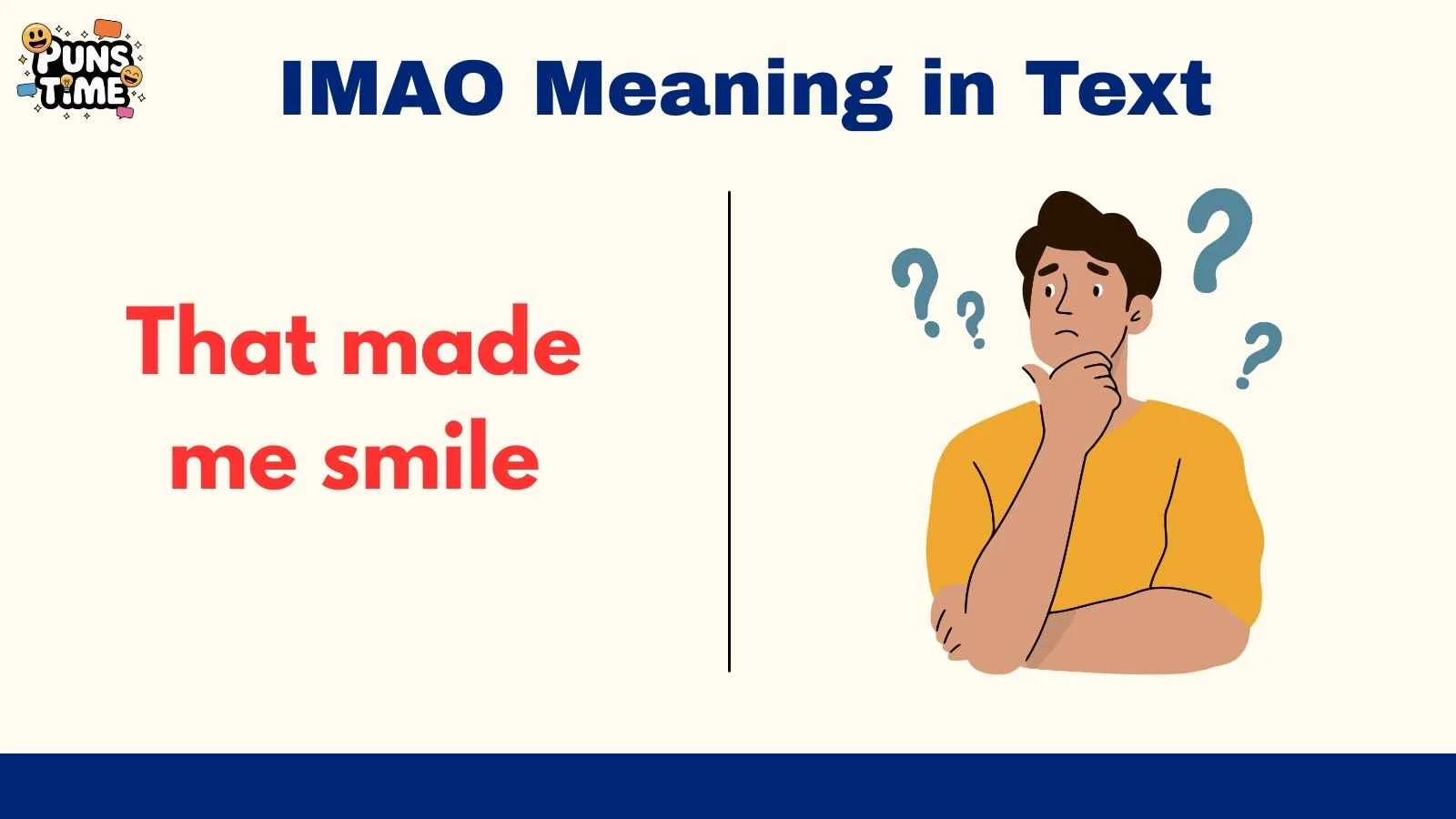
- “That made me smile”
- Playful or ironic humor
IMAO is rarely used in professional communication. You’ll mostly see it in:
- Private chats
- Group messages
- Comment sections
- Gaming or Discord servers
Because it’s informal, most people understand it instantly — even if it’s technically incorrect. Online language prioritizes emotion over grammar, and IMAO fits that culture perfectly.
Full Form, Stands For & Short Meaning of IMAO
Interestingly, IMAO does not have an official full form recognized across the internet. This is one reason people often feel confused when they first encounter it. Unlike acronyms such as LOL or BRB, IMAO emerged organically rather than being formally defined.
That said, users commonly associate it with:
- LMAO (Laughing My Ass Off) — accidental or intentional misspelling
- “I’m actually amused” — an interpreted meaning, not literal
- Soft laughter reaction — weaker than LOL or LMAO
In short, the short meaning of IMAO is simply:
“I found that funny.”
Some users jokingly invent backronyms like:
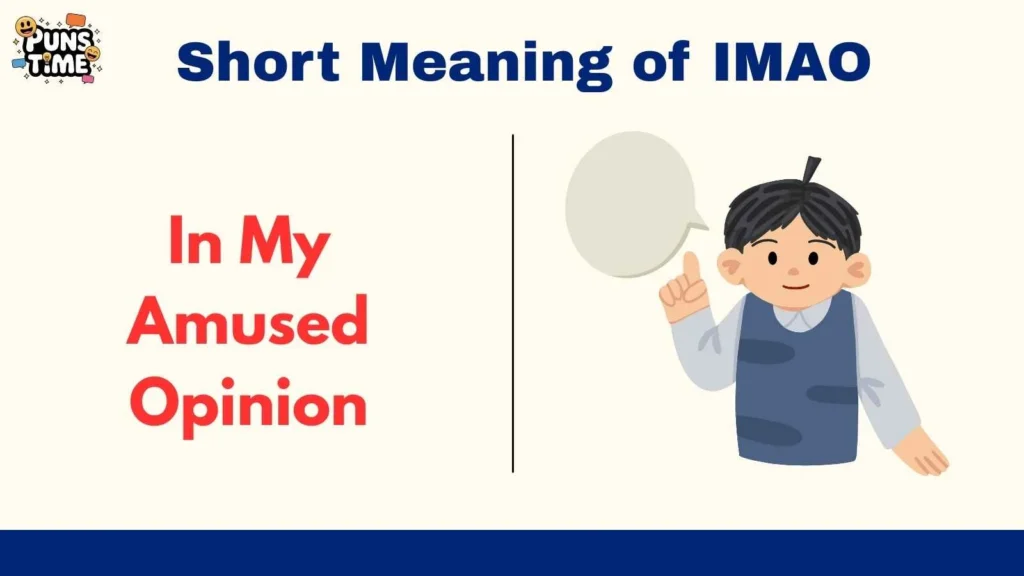
- In My Amused Opinion
- I’m Mildly Amused, Okay
But these are humorous interpretations, not real definitions.
What matters most is how it functions emotionally. When someone types IMAO, they are reacting — not explaining. It’s expressive slang, not structured language.
You’ll often see it used when:
- Something is mildly funny
- Someone reacts quickly without thinking
- The tone is casual and relaxed
Because texting is fast-paced, clarity matters less than vibe. IMAO delivers the message: “That made me laugh.” Even without a formal expansion, readers understand it instantly through context.
Origin, History & First Known Use of IMAO
IMAO does not have a documented invention date like older internet slang. Instead, it developed naturally through typing behavior and online culture. Its origin is closely tied to the popularity of LMAO in the early 2000s.
As mobile texting increased, so did typing errors. The letters “I” and “L” are close visually and sometimes autocorrect systems misread them. Over time, people began seeing IMAO often enough that it stopped being viewed strictly as a mistake.
By the mid-2010s, IMAO started appearing more frequently in:
- Twitter replies
- Gaming chats
- Meme comments
- Discord servers
At that point, users began using it intentionally — especially to convey less intense laughter than LMAO. In meme culture, exaggeration is common, so a “weaker laugh” needed its own style.
IMAO became part of ironic humor:
- Saying something is funny, but not that funny
- Reacting with dry amusement
- Keeping things casual
There is no official creator or first post credited with inventing it. Like many slang terms, it evolved through repetition rather than design.
This organic development is common online. Slang doesn’t wait for dictionaries — it spreads through shared understanding. Once enough people understand a term, it becomes “real” regardless of grammar.
How People Use IMAO in Daily Conversations
In everyday digital conversations, IMAO is used as a reaction word, not a statement. It usually appears at the end of a sentence or as a standalone reply.
People use it when:
- Responding quickly
- Reacting casually
- Showing light humor
- Avoiding dramatic expressions
Examples of daily use include:
- “That meme was wild IMAO 😂”
- “You really said that? IMAO”
- “Bro fell again IMAO 💀”
It often appears lowercase (“imao”) which reinforces its casual tone. Capitalization doesn’t change meaning — only vibe.
IMAO is commonly used among:
- Friends
- Classmates
- Online communities
- Gamers
It’s rarely used with strangers in formal contexts. Its purpose is emotional connection, not explanation.
Tone-wise, it can express:
- Light laughter
- Friendly teasing
- Sarcasm
- Playful disbelief
Because it’s ambiguous, people rely on emojis or context to clarify emotion. Adding 😂, 😭, or 💀 helps signal how funny something actually is.
In daily conversation, IMAO works best when the atmosphere is relaxed. It’s not meant to impress — it’s meant to flow naturally.
IMAO Meaning Across WhatsApp, Instagram, TikTok & Snapchat
While the core meaning stays similar, IMAO can feel slightly different depending on the platform.
On WhatsApp, IMAO usually signals friendly laughter in private chats or groups. It often appears with emojis and inside ongoing conversations. People rarely question its meaning here.
Example:
- “That voice note killed me IMAO 😂”
On Instagram, IMAO is often used in comments under memes or reels. Here, it sometimes carries ironic humor — laughing but not too seriously.
Example:
- “This is too real IMAO 💀”
TikTok
On TikTok, slang evolves rapidly. IMAO is commonly used as:
- A sarcastic reaction
- A casual laugh
- A comment filler
Users may type it intentionally to appear laid-back or ironic.
Snapchat
On Snapchat, IMAO appears mostly in quick replies. Since snaps are temporary, users type fast and casually — making IMAO feel very natural.
Across all platforms, the meaning remains:
“That’s funny.”
The difference lies in tone — from genuine laughter to dry humor.
Different Meanings of IMAO in Other Fields
Outside casual texting, IMAO has very limited formal meaning. It is not a recognized academic, medical, or technical abbreviation.
However, in rare cases:
- Some communities invent joke meanings
- Forums may assign temporary interpretations
- Individuals create personal meanings
These uses are not standardized and rarely extend beyond small groups.
In professional or educational fields, IMAO is generally not used at all. If it appears, it’s almost always informal or accidental.
So for practical purposes, its meaning remains rooted in online slang only.
Common Confusions, Mistakes & Wrong Interpretations
Many people misunderstand IMAO because of its similarity to other terms.
Common confusions include:
- Thinking it’s a new official acronym
- Assuming it has a dictionary definition
- Believing it means something serious
Some people misread it as:
- A typo that should be corrected
- An insult (it is not)
- A hidden abbreviation
In reality, it’s harmless slang. Overthinking it causes more confusion than necessary.
Another mistake is using it in formal writing. Emails, work chats, or academic messages should avoid it completely.
Context always decides meaning — not spelling.
Similar Terms, Alternatives & Related Slang
If you understand IMAO, you’ll easily recognize related expressions:
- LOL – Laughing out loud
- LMAO – Strong laughter
- ROFL – Extreme laughter
- LMFAO – Very intense humor
- 😂 emoji – Universal laughter
- 💀 – “That killed me” humor
Internal linking suggestions:
- Link to “LOL Meaning in Text”
- Link to “LMAO Meaning”
- Link to “💀 Emoji Meaning”
- Link to “Internet Slang Dictionary”
These help readers explore related terms and improve SEO structure.
Examples of IMAO in Real Chat Situations
Quick examples people actually use:
- “You really wore that? IMAO 😂”
- “That plot twist was wild IMAO”
- “He tripped again IMAO 💀”
- “Not you saying that out loud IMAO 😭”
- “This comment section IMAO”
These examples show how natural and casual the term is.
How to Reply When Someone Says IMAO
You don’t need to overthink your reply. Simple responses work best.
You can reply with:
- “😂😂”
- “I know right”
- “Glad you found it funny”
- “That was the point 😅”
- “IMAO same”
Matching the tone keeps the conversation smooth.
Is IMAO Still Popular? Trends & Online Usage
IMAO is moderately popular, especially among younger users and meme communities. It’s not trending globally, but it remains active in casual chats.
Why it still survives:
- Easy to type
- Feels natural
- Slightly ironic
- Fits meme culture
It may never replace LMAO, but it continues to exist as expressive slang — especially in informal spaces.
FAQs:
1. Is IMAO a real word?
No, it’s informal internet slang.
2. Does IMAO mean the same as LMAO?
Mostly yes, but usually lighter or more ironic.
3. Is IMAO a typo?
Often yes, but sometimes intentional.
4. Can I use IMAO in professional chats?
No, it’s too informal.
5. Is IMAO rude?
No, it’s usually friendly or humorous.
Conclusion:
Understanding the IMAO meaning in text helps you navigate online conversations with confidence. While it doesn’t have an official definition or full form, its purpose is simple: expressing amusement in a relaxed, casual way.
Whether typed accidentally or used intentionally, IMAO has become part of modern digital language especially in chats, memes, and social media comments.
Its meaning depends on tone and context, not grammar. When paired with emojis or playful messages, it clearly signals laughter or light humor.
As online slang continues to evolve, terms like IMAO remind us that communication isn’t always about perfection it’s about connection. Once you understand that, replying becomes easy and natural.